Also known as: Eratothenes
Date/time: 2011.11.05
Equipment: 76/900 Newtonian
Magnification and filter(s): 118x
Seeing: 7/10 Transparency: 3/5
Humidity: low
Wind: none
Location: Zákány, Hungary N46°14′ 59,2″ E16°57′ 15,3″
Observer: Bognár Tamás
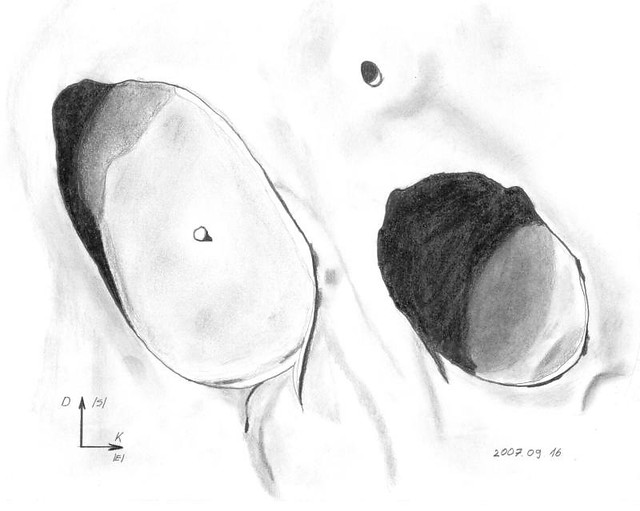
Eratosthenes is a relatively deep lunar impact crater that lies on the boundary between the Mare Imbrium and Sinus Aestuum mare regions. It forms the western terminus of the Montes Apenninus mountain range. The crater has a well-defined circular rim, terraced inner wall, central mountain peaks, an irregular floor, and an outer rampart of ejecta. It lacks a ray system of its own, but is overlain by rays from the prominent crater Copernicus to the south-west.
The Eratosthenian period in the lunar geological timescale is named after this crater. The crater is believed to have been formed about 3.2 billion years ago, defining the start of this time period.
At low Sun-angles this crater is prominent due to the shadow cast by the rim. When the Sun is directly overhead, however, Eratosthenes visually blends into the surroundings, and it becomes more difficult for an observer to locate it. The rays from Copernicus lie across this area, and their higher albedo serves as a form of camouflage.
In 1924, William H. Pickering noted dark patches in the crater that varied in a regular manner over each lunar day. He put forward the speculative idea that these patches appeared to migrate across the surface, suggestive of herds of small life forms. The idea received a degree of attention primarily due to Pickering’s reputation.