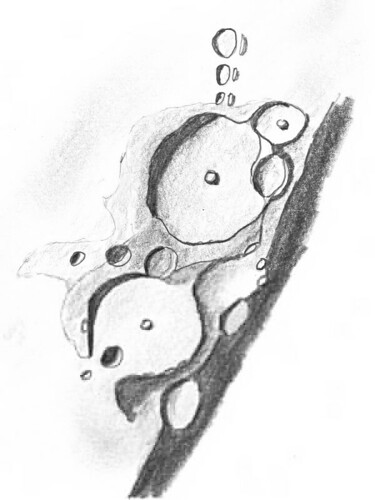
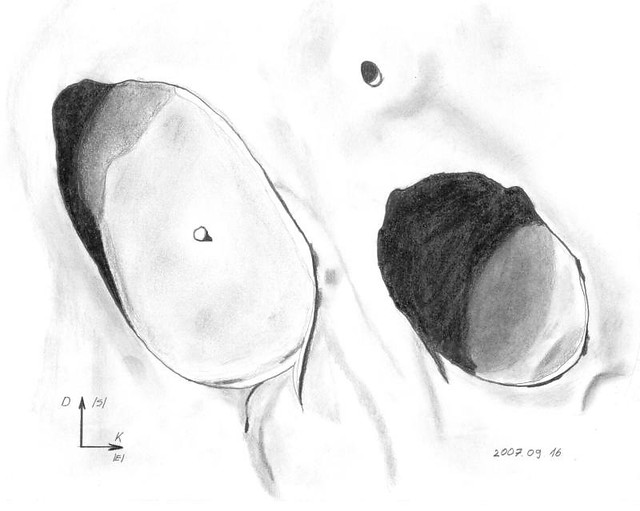
Also known as: Copernicus
Date/time: 2011.11.05 UT 19:50-21:00
Equipment: 76/900 Newtonian
Magnification and filter(s): 118x
Seeing: 7/10 Transparency: 3/5
Humidity: low
Wind: none
Location: Zákány, Hungary N46°14′ 59,2″ E16°57′ 15,3″
Observer: Bognár Tamás
Description:
Copernicus is a lunar impact crater named after the astronomer Nicolaus Copernicus, located in eastern Oceanus Procellarum. It is estimated to be about 800 million years old, and typifies craters that formed during the Copernican period in that it has a prominent ray system.

Copernicus is visible using binoculars, and is located slightly northwest of the center of the Moon’s Earth-facing hemisphere. South of the crater is the Mare Insularum, and to the south-south west is the crater Reinhold. North of Copernicus are the Montes Carpatus, which lie at the south edge of Mare Imbrium. West of Copernicus is a group of dispersed lunar hills. Due to its relative youth, the crater has remained in a relatively pristine shape since it formed.
The circular rim has a discernible hexagonal form, with a terraced inner wall and a 30 km wide, sloping rampart that descends nearly a kilometer to the surrounding mare. There are three distinct terraces visible, and arc-shaped landslides due to slumping of the inner wall as the crater debris subsided.